
Posted by Foy's Pet Supplies on Sep 5th 2026
Pigeon Leg Band Size Guide: What Size Band Does Your Pigeon Need?
A pigeon leg band looks simple until you are holding a young squab and trying to decide which size actually belongs on its leg. A band that fits one breed may be completely wrong for another, especially when comparing small tumblers, Racing Homers, show breeds, pouters and larger pigeons.
A permanent seamless band has to go on while the bird is still young enough for the foot to pass through it, while still fitting properly as the pigeon grows. For racing and showing, the type of band and the organization that issued it can matter too.
This pigeon leg band size guide covers common NPA band sizes by breed, AU bands for Racing Homers, when to band a young pigeon and what to check after the band is on.
What Size Leg Band Does a Pigeon Need?
The correct pigeon leg band size depends on the breed. Most pigeon breeds use bands ranging from about 7 mm to 13 mm, although smaller and larger sizes are available for certain breeds.
Smaller pigeons, including many tumblers and rollers, often use 7 mm or 8 mm bands. Medium-sized breeds may require 9 mm or 10 mm bands, while larger pigeons and heavily feathered breeds can need 11 mm, 12 mm or 13 mm bands.
For example, Racing Homers commonly use an 8 mm NPA band. Birds being banded for American Racing Pigeon Union competition should use the correct AU racing band, since racing organizations have their own band requirements.
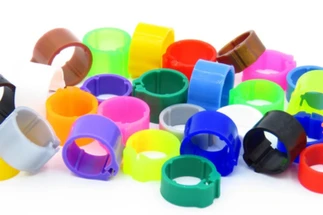
Foy's carries pigeon leg bands in a range of sizes and styles, including seamless yearly bands, snap-on bands, clip-on bands, lock rings and personalized bands.
Pigeon Leg Band Sizes by Breed
Pigeon leg band sizes vary by breed, with most common sizes ranging from 7 mm to 13 mm. We also carry NPA pigeon bands in additional sizes for breeds that fall outside that range.
7 mm Pigeon Bands
A 7 mm pigeon band is commonly used for smaller breeds such as American Flying Tumblers, Arabian Trumpeters, Archangels, Helmets, Italian Owls, Flying Tipplers, Flying Oriental Rollers, Parlor Rollers and Performing Rollers.
8 mm Pigeon Bands
An 8 mm pigeon band is used for breeds including African Owls, Chinese Owls, Fantails, German Modenas, Jacobins, Racing Homers, Show Rollers, Show Type Racing Pigeons and Voorburg Croppers.
9 mm Pigeon Bands
Breeds commonly using a 9 mm band include Antwerp Smerles, Classic Old Frills, English Magpies, English Owls, Exhibition Homers, German Beauty Homers, Maltese, Modenas and Polish Lynx.
10 mm Pigeon Bands
A 10 mm pigeon band is commonly used for American Show Racers, Carneaux, English Carriers, English Show Homers, Frillbacks, Show Kings, Strassers, Utility Kings and West of England Tumblers.
11 mm Pigeon Bands
Larger breeds such as French Mondains, Giant Homers, Indian Fantails, Lahores, Swiss Mondains and Giant American Crests may use 11 mm bands.
12 mm Pigeon Bands
A 12 mm pigeon band may be used for Indian Fantails, muffed Pouters and Croppers, and Saints.
13 mm Pigeon Bands
Some of the larger pigeon breeds use 13 mm bands, including Dutch Croppers, Ghent Pouters, Hungarian Giant House Pigeons, Pomeranian Pouters, Saxon Pouters and some Trumpeters.
When a breed appears under more than one recommended size, check the exact variety and current breed standard before ordering. Indian Fantails, for example, may fall into either the 11 mm or 12 mm range depending on the variety.
Why the Correct Pigeon Band Size Matters
The correct pigeon band size should stay securely on the leg without becoming tight or interfering with normal movement as the bird grows.
A band that is too small can press against the leg and may become a problem if the bird develops swelling from an injury. A band that is too large can move around excessively or be more likely to catch on loft equipment.
On an adult pigeon, the band should sit freely around the shank without pressing into the skin or affecting the foot and toes.
Band size also varies quite a bit between breeds. A small tumbler will not need the same size as a Show King, Mondain or heavily feathered pouter. That is why breed-specific sizing is more reliable than choosing a band simply because it looks close enough.
Fanciers keeping several breeds should sort and label their bands before breeding season so the correct size is ready when each youngster reaches banding age.
NPA Bands vs. AU Bands: What Is the Difference?
NPA bands are used across many fancy and performance pigeon breeds and are available in different sizes. Our NPA bands include the year, NPA identification, band size and an individual number.
AU bands are issued through the American Racing Pigeon Union for Racing Homers. Our AU Racing Homer bands are made in Racing Homer size, and the band color changes each year.
For birds that will compete in AU-recognized races, an approved seamless racing-pigeon-size band is required. AU bands are the standard choice for Racing Homers intended for AU competition. An 8 mm NPA or general identification band may physically fit a Racing Homer, but band size alone does not make the bird eligible for an AU-recognized race.
Racing fanciers should have the correct current-year bands ready before youngsters reach banding age. Once a squab's foot has grown too large for a seamless band, the normal banding window has passed.
When Should You Put a Leg Band on a Baby Pigeon?
Permanent seamless pigeon bands are usually fitted when a squab is around 5 to 7 days old, but the exact timing can vary with the breed and how quickly the youngster is growing.
The right time is when the band can pass over the foot without being forced and then stay securely on the leg. Some fast-growing squabs may be ready slightly earlier, while smaller or slower-growing youngsters may give you a little more time.
After the band is fitted, check the bird again over the next few days. A band placed too early can sometimes slip back over the foot and come off. Waiting too long creates the opposite problem, because the foot may become too large for a seamless band to pass over safely.
Never force a seamless band over a foot that has already grown too large. At that point, a removable identification band may still be an option for general loft use, but it will not replace an official seamless band required for certain racing or show purposes.
For anyone breeding several pairs at once, having the correct band sizes ready before the youngsters hatch makes the process much easier once they reach banding age.
How Should a Pigeon Leg Band Fit?
A pigeon leg band should sit freely around the shank without pressing into the skin or restricting normal movement. On an adult bird, it should have enough room to move slightly around the leg but should not be so loose that it can slip over the foot.
Check the band during normal loft care, especially as a young bird grows. Swelling, redness, damaged skin, limping or a band that appears to be pressing into the leg can indicate a problem.
A band that becomes tight because of swelling or injury should be dealt with promptly. Permanent seamless bands need to be cut off rather than pulled over the foot, so removal is best handled by an avian veterinarian or someone experienced with safe band removal.
Seamless vs. Snap-On and Clip-On Pigeon Bands
Seamless pigeon bands are permanent closed rings fitted while the bird is still a young squab. They are commonly used for official identification and may be required for certain racing or show purposes.
Snap-on, clip-on, spiral and lock-style bands can be fitted later and are often used for loft identification, marking breeding pairs or separating groups by color.
Foy's carries both permanent and removable pigeon leg bands. Before choosing a size, check which type of band you need, since a removable identification band does not replace an official seamless band required by a racing or show organization.
What Information Is on a Pigeon Leg Band?
The information on a pigeon leg band depends on the banding system.
An AU racing band typically identifies the organization, year, club and individual bird number. This information can help trace a found racing pigeon back to the club connected with the bird.
NPA bands sold by Foy's include the year, NPA identification, band size and an individual number.
For racing pigeons, keeping accurate records alongside the band number makes it easier to follow a bird's performance over multiple seasons. Our article on training old birds also covers why keeping race results and other records can be useful when evaluating older racers.
When Do Personalized Pigeon Bands Make Sense?
Personalized pigeon bands can add contact information that is easy to recognize if a bird is found away from the loft. They can be especially useful for pet pigeons, white bird release businesses and other birds where an owner's name or phone number may help someone make contact quickly.
Foy's personalized pigeon leg bands can be printed with custom information and consecutive numbers for easier identification.
Personalized bands are generally used as an additional form of identification. They do not replace an official AU or NPA band when a racing or show organization requires one.
Find the Right Pigeon Leg Bands
Choosing the right pigeon leg band comes down to three things: the breed, the band size and what the band will be used for. A Racing Homer entered in AU competition needs a different type of band than a fancy pigeon being shown or an adult pigeon that only needs an easy-to-read identification ring.
We carry pigeon leg bands for racing, showing, breeding and everyday loft identification, including NPA yearly bands, AU Racing Homer bands, seamless bands, snap-on bands, clip-on rings, lock rings and personalized options.
Check the recommended size for your breed before ordering, and keep current-year seamless bands ready before young pigeons reach banding age.