
Posted by Foy's Pet Supplies on Oct 27th 2026
Best Perches for Pigeons: V-Perches, T-Perches and Platform Perches
Pigeons spend a large part of the day resting above the loft floor, so perch choice affects both the birds and the way the loft is managed. The right setup gives each pigeon a regular resting place without crowding the wall or making cleaning difficult.
For most pigeon lofts, V-perches and T-perches are practical choices for individual resting spaces, while platform perches give larger pigeons or birds that prefer a broader surface more room under their feet.
The best option depends on the pigeons you keep, the available wall space and how much room you can give each bird.
What Type of Perch Is Best for Pigeons?
V-perches are a strong all-around choice when several individual pigeon perches need to fit along the same wall. T-perches suit simpler, more open layouts, while platform perches provide a wider surface for pigeons that need or prefer more room.
Each pigeon should have its own usable resting place. The perch also needs to be stable, large enough for the bird and positioned where the pigeon can land without interfering with nearby birds.
The shape matters, but dimensions matter too. A perch suitable for a Racing Homer may feel cramped for a much larger fancy pigeon, so check the actual width and depth before ordering.
V-Perches for Pigeons
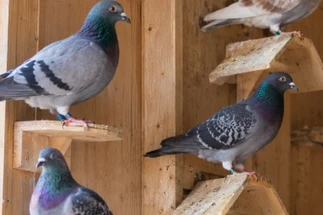
V-perches are designed for individual birds and make efficient use of vertical wall space. The angled sides give each pigeon a defined place to settle and provide some separation from neighboring birds.
Our Wood V Perch can be installed in vertical rows. The design also helps reduce the amount of droppings reaching a pigeon positioned below another perch.
For larger birds or fanciers who prefer a heavier wooden design, the Foy's Heavy Duty V Perch is made from yellow pine and provides a wider standing surface.
V-perches are particularly useful in racing and young-bird sections where several pigeons need individual wall spaces without adding large shelves around the loft.
T-Perches for Pigeons
T-perches have a simple horizontal resting surface with open space around the bird. They take up little wall area and leave fewer surfaces around the pigeon for droppings to collect on.
That open construction also makes routine cleaning straightforward. Much of the waste falls to the floor below rather than sitting on a wide shelf or enclosed perch.
T-perches suit loft sections where the birds already have enough space between resting positions and do not need the added side separation of a V-perch.
They are also useful for fanciers who want a clean, uncomplicated perch wall with easy access around each position.
Platform Perches for Pigeons
Platform perches give pigeons a broad, flat standing area rather than a narrow individual perch.
They can work well for larger fancy breeds, older pigeons or individual birds that repeatedly choose shelves and other wide surfaces for resting. The extra area allows the pigeon to shift position without balancing on a narrow perch.
The tradeoff is wall space. A platform takes up more room than a T-perch or compact V-perch, so it is usually better used where the extra surface is actually useful rather than covering an entire wall with platforms.
Flat surfaces also collect more droppings, so platform perches should be installed where the full surface can be reached easily for cleaning.
Wood vs. Plastic Pigeon Perches
Wood and plastic can both work well in a pigeon loft. Wooden perches are sturdy and can be painted or sealed to create a smoother surface for cleaning. Check unfinished wood regularly for splinters, rough edges and areas where moisture has been absorbed.
Plastic perches are easy to wash and do not absorb moisture in the same way unfinished wood does. Removable plastic designs can also be convenient when the loft is being cleaned thoroughly.
Material should come after fit and stability. A well-sized wooden perch securely mounted to the wall is more useful than a plastic perch that flexes or moves when the pigeon lands on it.
How Many Perches Does a Pigeon Loft Need?
Provide at least one usable perch for every pigeon in the section. A few extra resting spaces are useful, particularly in a young-bird loft where pigeons are still choosing their regular spots.
A loft holding 20 pigeons should therefore have at least 20 practical resting positions rather than expecting several birds to share limited wall space.
Count the places pigeons can actually use. A perch placed too close to a wall, squeezed beneath another perch or positioned where a dominant pigeon constantly guards it may not function as a useful resting spot.
Having enough individual spaces also makes it easier to notice changes in behavior. Once pigeons establish their usual places, a bird that suddenly stays on the floor or avoids its normal perch is easier to spot.
How Should Pigeon Perches Be Spaced and Positioned?
Leave enough room for each pigeon to land, stand and turn without contacting the birds on neighboring perches. Larger breeds need more clearance than smaller pigeons, so there is no single spacing measurement that fits every loft.
For vertical perch layouts, avoid positioning one bird directly beneath another where droppings can fall onto the lower pigeon. Perches designed for stacked installation can reduce this problem.
Keep the main perch wall away from feeders and drinkers. A heavily used resting spot above feed or water increases the chance of contamination and creates unnecessary cleaning.
The birds also need a clear approach to the perch. Feeders, nest boxes and other equipment should not block the flight path to the wall.
After installation, watch how the pigeons use the setup. Persistent fighting for certain positions, unused perches or birds regularly sleeping on the floor can indicate that the spacing or location needs adjustment.
Keeping Pigeon Perches Clean
Perches should be cleaned as droppings build up rather than waiting until they are heavily soiled. Pigeons tend to return to the same resting places, so a few popular positions may need attention more often than the rest of the wall.
T-perches usually leave most waste on the floor beneath them. V-perches may need scraping around the sides and back, while platform perches have a larger flat surface that requires regular cleaning.
Use cleaning time to inspect the perch itself. Tighten loose mounting hardware and replace cracked plastic, damaged wood or any perch that has started pulling away from the wall.
Our guide on how to clean a pigeon loft covers perch, floor, feeder and drinker cleaning in more detail.
Shop Pigeon Perches for Your Loft
Choose perch styles according to the birds and the amount of usable wall space in the loft. V-perches make efficient individual resting spaces, T-perches keep the layout open, and platform perches provide additional surface area where it is needed.
We carry pigeon perches in wood and plastic designs, including V-perches, T-perches, platform perches, clip-on perches and space-saving options.
Check the dimensions and mounting style before ordering, and plan enough usable perch spaces for every pigeon in the section.